
- Owned performance-critical components from concept to track, across gearbox, chassis, floor, wings and suspension assemblies.
- Worked across past, current and future car programmes, supporting conceptual development, design evolution and track delivery.
- Defined laminates, tooling, cores, inserts and materials, balancing performance, weight and cost.
- Collaborated with Aerodynamics, Structures and Manufacturing to resolve & improve design, packaging and production requirements
- Delivered Class-A component and assembly drawings, composite plybooks and manufacturing definitions, applying GD&T across performance-critical components and assemblies.
- Developed robust surfacing and parametric strategies to maintain design quality through rapid iteration.
- Embraced new and unfamiliar challenges with a positive, open-minded approach, learning quickly, supporting the team and continually seeking opportunities to improve ways of working.
- Demonstrated ownership, discipline and a collaborative mindset, proactively solving challenges and driving continuous improvement against demanding performance, timing, cost and weight targets.
- Gained hands-on exposure to ATLAS telemetry, analysing track data to understand component loads, operating conditions and vehicle behaviour, linking real-world performance data back to engineering decisions.
- Prepared and managed regulatory documentation for FIA submission, ensuring compliance and timely delivery.
PEOPLE · EXPERIENCE · ENGINEERING · MOTORSPORT
ABOUT ME
The experiences, interests and opportunities that have shaped my journey through engineering and motorsport.
SITA MORJARIA
DESIGN
ANALYSIS
PERFORMANCE
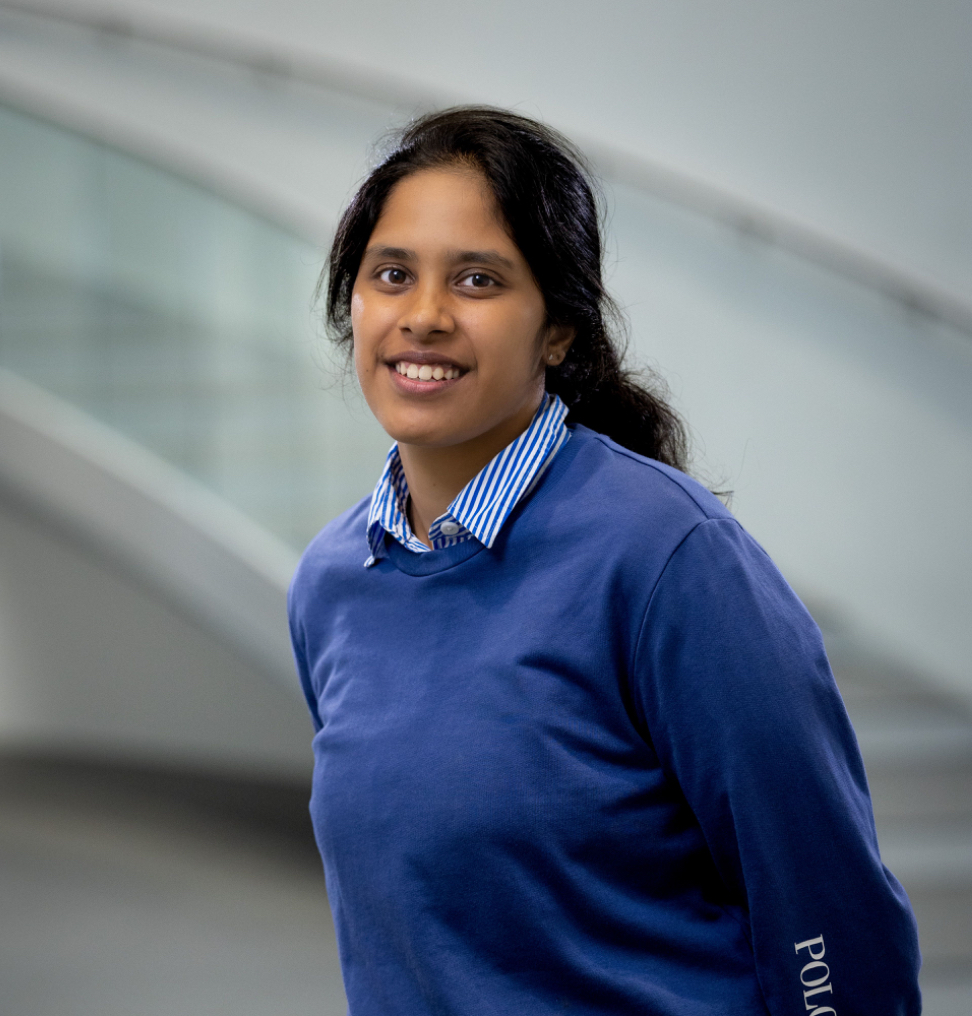
My path into engineering started with a habit of breaking things — taking them apart to see what was behind the exterior and, eventually, developing a desire to understand how and why they worked. That curiosity sparked an interest in cars and engineering, and has continued to shape the path I have taken.
Growing up in a competitive sporting environment and competing internationally in both badminton and tennis taught me the importance of teamwork, communication, hard work and discipline — but above all, to never stop at the first attempt. That drive, combined with a naturally competitive mindset, has shaped my determination to continually learn, improve and pursue opportunities within motorsport.
Today, I study Mechanical Engineering at the University of Warwick while continuing to build my experience in motorsport. What started with taking things apart simply to understand how they worked has developed into a genuine curiosity for why things perform the way they do — and how engineering can be used to challenge their limits and make them faster.
MY JOURNEY
EXPERIENCE
- Led vehicle-level CAD and manufacturing delivery for a fully integrated electric motorcycle, managing 7 complex, multidisciplinary assemblies.
- Directed a 25-member engineering team, owning concept development, CAD maturity, manufacturing strategy, and final assembly.
- Engineered and validated a high-performance battery and mounting system, balancing stiffness, safety, thermal considerations, and manufacturability within 2-months
- Acted as the primary technical interface for DFM, materials selection, tolerancing, and system integration decisions
- Implemented part tracking, build visibility, and schedule control to manage critical paths and production readiness.
- Delivered 2 complete motorcycles in 10 months, achieving 7th place out of 42 international teams for CAD quality and prototype delivery.
- Used Rhino, Grasshopper and Butterfly to develop geometry, extract engineering data and perform CFD analysis.
- Designed a windcatcher funnel in CAD and manufactured prototypes using SLS printing and laser cutting.
- Participated in engineering consultancy and design reviews, supporting multidisciplinary design development.
- Produced technical reports and presentations in Adobe InDesign for director-level design reviews.
- Presented simulation results, technical findings and design recommendations to Directors, Associates and key project stakeholders, producing high-quality reports and presentations to support design approval and decision-making.
- Gained hands-on experience in experimental setup, testing and MATLAB-based analysis of qualitative and quantitative data for composite manufacturing processes.
- Worked with traditional and automated composite manufacturing techniques, gaining practical exposure to advanced industrial manufacturing equipment and processes.
- Used MATLAB to analyse differential cooling behaviour of moulded carbon-fibre components, identifying opportunities to improve cooling uniformity and manufacturing efficiency.
- Designed a cooling fixture in SolidWorks, informed by differential cooling analysis to optimise component cooling and improve the manufacturing process.
- Led a team of 6 to development manufacture the first-ever aero package across 6 months.
- Conducted CFD simulations using Star CCM+ to optimise the 400N downforce package.
- Leveraged CAD skills to design and communicate optimal manufacturing routes in collaboration with the team within the space of 3 months.
- Built fully parametric CAD models, enabling rapid iteration aligned with evolving performance targets and packaging constraints.
- Developed understanding of composite manufacturing processes, with a focus on resin infusion, evaluating process limitations, manufacturing constraints and their impact on component quality.
- Applied Cetol 6σ, RecurDyn, Particleworks and SolidWorks to dynamic modelling and engineering simulation.
- Supported engineering consultancy projects using CAD, CAE, and MPS tools.
- Assisted with GD&T analysis, multi-body dynamics, and simulation-led design decisions.
- Contributed to both technical delivery and client-facing project outputs.
- Developed Python and JavaScript programming skills, applying them to engineering simulations and data-driven analysis.
- Collaborated within an international engineering team to develop a high-performance electric race car.
- Designed and analysed vehicle components using CAD, material testing and engineering calculations.
- Developed steering geometry using Ackermann principles and rack-and-pinion kinematics.
- Analysed front and rear-wing aerodynamics using CFD to support aerodynamic package development.
- Applied engineering calculations to powertrain parameter optimisation.
CONTINUED GROWTH
PERSONAL DEVELOPMENT
- Developed a stronger foundation in tyre behaviour, lateral dynamics, load transfer, suspension geometry and vehicle balance.
- Applied vehicle dynamics theory through mathematical modelling and simulation, including steady-state and transient vehicle response.
- Explored the linear bicycle model and frequency-response analysis to understand yaw response, stability and handling characteristics.
- Investigated how setup parameters, suspension characteristics and aerodynamic behaviour influence overall vehicle performance and balance.
- Built understanding of performance-development tools including K&C, multi-post rig testing, lap-time simulation and Driver-in-the-Loop simulation.
- Strengthened the link between simulation, physical testing and vehicle data, supporting a more multidisciplinary approach to performance engineering.
- Developed an understanding of CAN network architecture and the physical layer, including CAN High/Low differential signalling, bus topology, termination and communication between ECUs, sensors and actuators.
- Learnt to interpret and decode CAN frames, working with message IDs, binary and hexadecimal data, signal bit positions, scaling factors and offsets to convert raw data into meaningful engineering values
- Built an understanding of CAN arbitration and message prioritisation, including how message IDs determine network access and how bus loading and transmission rates influence communication.
- Applied Big Endian (Motorola) and Little Endian (Intel) byte ordering to correctly interpret multi-byte signals and diagnose common decoding errors
- Gained practical experience with DBC databases, defining messages, signals, units, scaling, offsets and endianness to translate raw CAN traffic into usable vehicle parameters.
- Developed practical understanding of CAN bus analysis tools, using PCAN-View and CAN interfaces to monitor network traffic, construct and inject CAN messages, and validate ECU responses for functional testing and fault diagnosis.
- Applied CAN reverse-engineering techniques to isolate and decode unknown signals from controlled vehicle inputs, supporting system validation, troubleshooting and data acquisition.
- Developed parametric aerodynamic surfaces from initial wireframes through to fully controlled surface geometry using CATIA 3DEXPERIENCE.
- Applied tangency, curvature and surface-continuity principles to create smooth, robust aerodynamic geometry.
- Used construction and reference surfaces to control intersections, feature relationships and downstream geometry.
- Built structured, parameter-driven model trees enabling rapid geometry changes without rebuilding the complete CAD model.
- Created interchangeable geometric features to support efficient concept iteration and comparison between design variants.
- Incorporated regulatory legality volumes and dimensional constraints directly into the CAD environment to continuously assess concept compliance.
- Applied an F1-style aerodynamic development workflow, balancing geometric control, design flexibility and regulatory constraints throughout concept development.
- Built a strong foundation in Formula 1 aerodynamic principles, including pressure distributions, boundary-layer behaviour, vortex structures and aerodynamic balance.
- Developed understanding of the F1 aerodynamic development process, applying structured problem-solving, concept evaluation and performance-led decision making.
- Strengthened capability in CFD analysis and interpretation, assessing flow structures and aerodynamic performance within an iterative development workflow.
- Explored CFD and wind-tunnel correlation, developing an understanding of how simulation results are validated against physical testing and sources of correlation error are identified.
- Connected aerodynamic performance to vehicle and lap-time performance, considering circuit characteristics, aerodynamic balance and setup trade-offs.
- Selected as 1 of 14 students nationwide for the Aleto Foundation × Aston Martin F1 Leadership Programme, an 11-month initiative focused on leadership, professional development and careers within Formula 1.
- Completed 12+ one-to-one mentoring sessions with a Senior R&D Engineer at Aston Martin F1, developing insight into F1 test and development processes, engineering career pathways and industry practices.
- Strengthened leadership, communication, presentation and teamwork through collaborative challenges, professional development activities and engagement with engineers and industry leaders.
- Completed a one-week placement at the Aston Martin F1 Campus, gaining first-hand exposure to the technical and operational environment of a Formula 1 team while developing professional and networking skills.
- Selected as 1 of 60 scholars from 750+ applicants for the McLaren 60 Scholars Programme, a competitive STEM development initiative.
- Built a strong STEM and professional network through mentoring, development activities and events at the McLaren Technology Centre, with exposure to programme partners including Google, Cisco and Deloitte.
- Developed leadership, professional and career skills through engagement with McLaren and partner organisations, complemented by continued technical and professional upskilling through Udemy.